Showing posts with label digital storytelling. Show all posts

Saturday, August 27, 2016

Windows and Mirrors: Media Artists' Door

"With access to mirror texts, students are able to see that their narrative matters, and with access to window texts, students learn to understand and appreciate the narratives of others."

The above is a quote from Chad Everett's guest blog post on Scholastic.com about the need each student has to be able to see herself in each field of study, and to read about success stories about people like her that open up new worlds of possibility as she imagines goals and dreams for her future.

I learned from personal experience as a white cis hetero able man that it's equally important for students of dominant identity groups to see and read stories about a diversity of peoples. I found out the hard way many times how little I knew about how to live in a country with all kinds of folks. I have so much to learn from listening to stories about non-dominant life experiences that are very different from my own.

One thing I'm doing this year is dramatically upping the mirrors and windows in my Media Arts classroom. This room serves 7th to 12th grade students, so I selected artists that meet a variety of audiences and whose well-known work is appropriate for at least portions of this age range. All of these featured artists identify as women, people of color, and/or LGBTQ.


The photos are up on a door that leads into a maintenance closet. The door is always locked. I am thinking of telling the kids that the key to unlocking this door doesn't look like a regular key. It's a work of media art they need to make. It's a story that only they can tell.

I could maybe arrange for a surprise to be behind this door on the last day of class, heehee!

Here's a list of the artists (I'm sure I'll be adding to it!)

Intisar Abioto
Haifaa Al-Mansour
Pedro Almodovar
Ana Lily Amirpour
Kathryn Bigelow
Luis Buñuel
Jane Campion
Niki Caro
Gurinder Chadha
Lisa Cholodenko
Ta-Nehisi Coates  
Ryan Coogler
Sofia Coppola
Alfonso Cuarón
Guillermo del Toro
Maya Deren
Lena Dunham
Ava Duvernay
Nora Ephron
Reggie Fils-Aimé
Nina Freeman
Tavi Gevinson  
F. Gary Gray
Vi Hart
Aureia Harvey
Todd Haynes
James Hong
Laura Hudson
Robin Hunicke
Alejandro González Iñárritu
Patty Jenkins
Miranda July
Wong Kar-wai
Merritt Kopas
Akira Kurosawa
Spike Lee
Annie Leibovitz
Kasi Lemmons
Penny Marshall
Steve McQueen
Shigeru Miyamoto
Hayao Miyazaki
Mira Nair
Yoko Ono
Yasujiro Ozu
Tyler Perry
Kimberly Pierce
Sarah Polley
Prince
Gina Prince-Bythewood
Zoë Quinn    
Dee Rees
Anita Sarkeesian
Cindy Sherman
John Singleton
Will Smith
Penelope Spheeris
Julie Taymor
Gus Van Sant 
Lana Wachowski
Lilly Wachowski
Glynn Washington
Carie Mae Weems
Lina Wertmüller 
Lindy West
Oprah Winfrey
John Woo
Jennifer Yuh Nelson
Karla Zimonja


Sunday, April 17, 2016

Student Inspiration Boards on Pinterest Build Connection within the Classroom

Inspiration is the energy that drives students to act independently.

The stories that inspire us are precious. They contain that potential to drive us to realize our dreams.

We hold these stories so close, that we actually make them a part of us.

Lately, I've been really inspired by Lin Manuel Miranda's Broadway musical, Hamilton. I didn't write it, I've never seen it, but I have memorized some of the songs. They're now a part of me - I stored every note and lyric in my brain, and I'm singing it to myself as I do the dishes and push in the chairs in my classroom.

A great way to get to know my students is to ask them to share what inspires them. This insight really helps me to shape future units and lessons. It also bolsters a student's pride in self to proclaim to the class, 'these are the things that inspire me.'

A really easy way to do this is to make a Pinterest board about it!

I've found it easy to simply use a classroom Pinterest account that I control. I just share the email and password out to my students, and they all log in.

First, I share with them my own inspiration board:
Follow Brendan's board Brendan's Inspiration Board on Pinterest.

I explain that the content of this board has played a huge role in forming who I am today.

Next, the students get to start their own boards. They each create their own within the same account. For example, 'Dylan's Inspiration Board.'

BTW I always email the parents first, letting them know that students will be using a social media platform, and that whatever personal information they post is on a private page (Pinterest calls them 'secret' boards), and that they're not creating their own social media accounts - they're using one I've created for classroom use.

Searching for 'pins' on Pinterest is super fun! It's amazing to look up Minecraft, for example, and find so many images, links, and other kinds of content about a single subject. A student can get very specific, and this helps create that sense of self that begins to form digitally on the board.

The best part is that, once a student finishes a board, it's instantly ready to be shared with the class! Just connect a computer to a projector, log in to the classroom Pinterest account, and let the presentations begin!

Here are some screenshots of boards my students have created. Notice how unique they are from each other! These boards can build connection between everyone involved.


Monday, February 22, 2016

Teaching a Systems Approach to Segregation


Systems are all around us. Sometimes we call a system a system: the public school system, or the political system, for example.

Other times, we don't call a system a system. This doesn't make it any less a system. We might call it the NBA Draft, or the college admissions process.

Sometimes people deny that a system is a system. You can rely on people to deny the systemic properties of racism, for example.

Systems are easy to teach when you have a clear model available to share and experiment with.

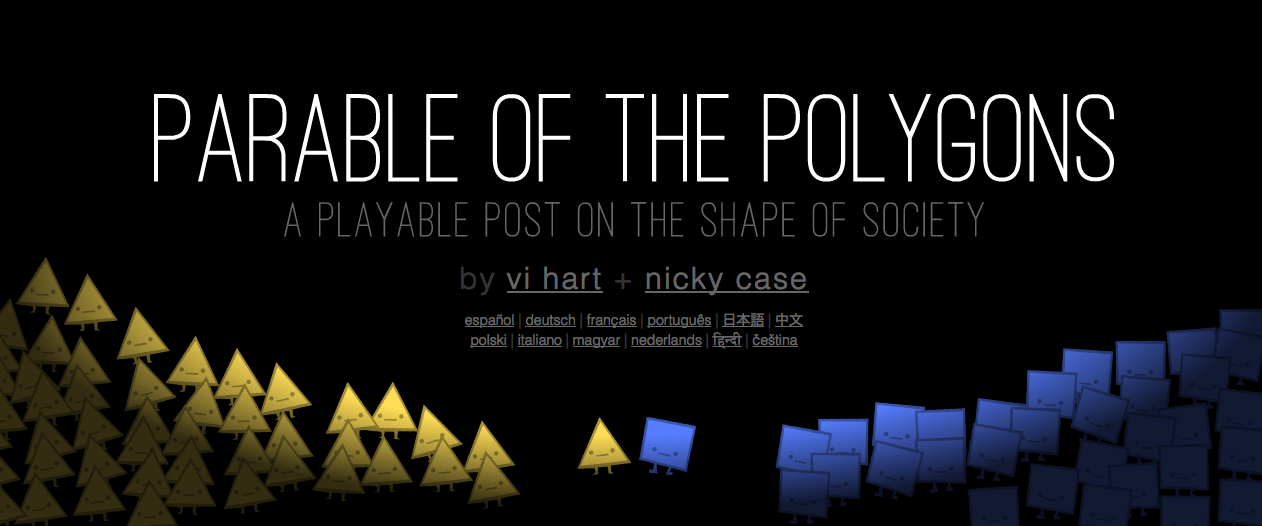
Thanks to Vi Hart @vihartvihart and Nicky Case @ncasenmare, we now have a fun, interactive model to understand systemic segregation that's appropriate for kids (and adults) of all ages!

Parable of the Polygons

http://ncase.me/polygons/

I heard about this model over the weekend and was so excited about it, I tried it out on my 7th grade media arts students today. I didn't even give them their own machines, I just walked them through it.

Even then, the students were totally able to grasp the rules of the system, and understand how systems create the world around us. They were entranced. One student who was class clowning that day remarked without irony, "Whoa, this is, like, really deep."

Next time, I'm going to set each student up at a machine, so they can click and drag through it on their own - experimenting, testing, hypothesizing, and proving their own assumptions either true or false.

Systems are important in media arts, because when you tell a story, you create a system for the audience. You create a setting, and you define (implicitly or explicitly) its boundaries. You create characters, and you define the parameters of their interaction. You define what powers each character has, and the latitude for each in terms of ability and mobility. You define what success and failure means in this system. Most important of all: when you mass communicate a system and it becomes popular, it inspires audience members to deploy that system in real life. Thus, we must be cautious as storytellers what systems we're popularizing.


Sunday, January 4, 2015

Digital Storytelling: #MyZeitgest 2014 Winners

I am definitely encouraging students to participate in this contest next year!  It's a testament to the power of digital storytelling when put into the hands of students.  Watch the winning video below.

Click here for the full post

From PBS NewsHour:

We asked students which events had the biggest impact on the world in 2014, and they answered. More than 1,000 students created multimedia projects on Trio and Meograph exploring the most newsworthy stories of year. It was a difficult decision, but our judges narrowed it down to the six winners below. For more great submissions, check out the Trio and Meograph finalists.

From all of us at NewsHour, Google and Trio, congratulations!


Tuesday, December 2, 2014

The Danger of a Single Story by Chimama Ngozi Adichie

This TED talk by Chimama Ngozi Adichie allows us a glimpse into the reason we as a species are endlessly, helplessly enthralled by stories.  

Stories shape our view of the world in ways that have far-reaching consequences.

Through digital storytelling, students can gain an appreciation not just for the communicative power, but also for the enduring effects that a story can have on cultures for years and generations to come.


Tuesday, September 30, 2014

30 Day Blogging Challenge from Te@chThought: Day 30

In response to the recent challenge from te@chthought, I'm participating in a 30 day blogging mission, starting September 1st!

And this is the last day!

Day 30
What would you do (as a teacher) if you weren’t afraid?

Wow, this question seems to directly respond to my last post, where I explain how I've changed in the last 7 years of teaching

How comfortable am I in sharing who I really am?  Being a teacher is a weird thing.  In grad school they told us that one teacher got fired because she was tagged on facebook drinking a glass of red wine in a photo from her trip to France.

What?

I know a few teachers who divide themselves between their school personae and their personal lives.  I did that for awhile when I was singing in a band.  Is this the real life?  Is this just fantasy?


My biggest change was overcoming this fear.  How did I know I'd beat it?  Suddenly I felt free to teach what really mattered to me, and I stepped back one day and thought, "Whoa, where'd all this curriculum come from?  Why wasn't I doing this earlier?"

I was afraid to do something that hadn't been done in the middle school before, and I was mostly afraid of the parents' reactions.  I found out all I had to do was communicate it ahead of time.
  • I led the school in a 360 degree assessment of diversity and inclusivity.  The school cannot grow unless it is always reflecting on the strength of its own community.
  • My childhood fascination with designing my own video games, which was hardly possible for a 12 year old in 1991, is now not only possible, but immediately gratifying!  GameSalad, Gamemaker Lite, Pixel Press Floors, Unity, Source Filmmaker, and more.  This is an excellent way for students to learn computer programming and digital storytelling.  I unpacked one of my storage boxes from childhood and brought it to one of my classroom cabinets:
  • Several education futurists praise Minecraft's educational potential.  I took the risk last week and offered a project to a couple students to create a scale model of the school campus in Minecraft, which will be linked via Aurasma's GPS functionality to offer the option of jumping between the real world and the 8th-grade-student-generated minecraft world with a few swipes of a mobile device's touchscreen.  I wasn't quite sure about it - I didn't trust the students fully - but I saw the progress yesterday, and OMG.  The creative ways they built the soccer field goals!!  The mathematical ratios they used to determine scale!  When I saw the gym, I got a little vertigo walking down the hall and into the locker room of an incredibly accurate architectural rendering.  At the time, they were building a machine that allowed the bleachers to open and collapse at the push of a button.  Engineering!
  • I'm leading a social media safety class that asks the question, "How can social media be used safely to help me reach my goals and dreams?" I was inspired by my friends who have successfully used crowd sourcing sites like Kickstarter and Indiegogo to do amazing things like record an album or invent a 3D printer that prints in metal.  I'm able to present this to 11-year old kids, who aren't even supposed to be using social media yet.  They can be guided by trusted adults on safe usage BEFORE THEY EVEN SIGN UP!  Imagine that! (And many are already using it anyway - social apps are kind of the biggest deal right now)
  • Projection mapping for the school plays?  Didn't know how to do it but there's FREE SOFTWARE to make it happen!  And tutorials on youtube!


We live in a beautiful world, and I am no longer afraid to share it in my classroom.

Also: 30 DAY BLOGGING CHALLENGE COMPLETED!  Achievement get!


Sunday, September 28, 2014

30 Day Blogging Challenge from Te@chThought: Day 28

In response to the recent challenge from te@chthought, I'm participating in a 30 day blogging mission, starting September 1st!
Day 28
Respond: Should technology drive curriculum, or vice versa?
I don't think it's like that.  The student should drive both.  What is the reality of technology use in the world that our students are growing up in?  I pay attention to what technology they're using outside the classroom.  My middle schoolers are using their parents' smartphones, their own ipods, xbox, google docs, online gaming, instagram, snapchat, skype...
Next step, teach with those technologies in the classroom.  And teach how to use them responsibly, with health and safety in mind.  The class content vehicle is student-driven.  Relevance is key.  For Media Arts, I'm not going to ask my school to invest in a bunch of cameras when there are cameras on the devices in their lockers not being used.  #BYOD (bring your own device)
Curriculum also looks at the student's world.  Media Arts in general ought to teach kids about voice, mass communication, storytelling, media literacy, collaboration / teamwork, project management, and how to take a good photo.  Now - when I apply this to instagram, for example, I need to consider what the student's needs, desires and definitions of success are for that medium.  The curriculum is shaped to the student's real world experiences.
Technology has been a hot topic in education for a long time, and for obvious reasons.  Computers have ruled the realm of knowledge acquisition and application since their invention, gaining ground in this arena year after year at a dramatic rate.  Ever since the day in 1983 when all those classrooms got Apple IIe computers, technology has been an integral part of education.  Curriculum of course has been around a whole lot longer, but from our students' perspective, there's no priority between the two.


Wednesday, September 24, 2014

30 Day Blogging Challenge from Te@chThought: Day 24

In response to the recent challenge from te@chthought, I'm participating in a 30 day blogging mission, starting September 1st!

Day 24
Which learning trend captures your attention the most, and why? (Mobile learning, project-based learning, game-based learning, etc.)

The one that's got me fired up right now is Design Thinking.  The way I see it, it's project-based learning in its purest form.

I'm facilitating Design Thinking in a small team of 5 middle schoolers who signed up to build an Identity Booth.

Ever heard a StoryCorps recording?  These 5 students are going to create something like that!

Right now, my school is in the process of learning about / reflecting on Identity.

The questions students, employees, and families are thinking about this year:
  • What is identity?
  • How is identity developed?
  • How does my understanding of identity development support my role in our school?
As a teacher, I'm merely guiding students into the design thinking process:

What I love about this process is that it's student-driven from the very beginning.
  1. Students need to develop a sense of empathy for their creation's ideal end user. 
  2. Next, they need to define their focus.
  3. Brainstorming!
  4. Creating the first prototype.
  5. Testing it out - a lot!
The cycle repeats itself again and again until the product has achieved the designers' goals.

More info as this project unfolds!


Tuesday, September 23, 2014

30 Day Blogging Challenge from Te@chThought: Day 23

In response to the recent challenge from te@chthought, I'm participating in a 30 day blogging mission, starting September 1st!

Day 23
Write about one way that you “meaningfully” involve the community in the learning in your classroom. If you don’t yet do so, discuss one way you could get started.

I can't wait to make this upcoming project a reality:


There's a map in the main office of our school that parents, visitors, and other community members can see every day.  It labels the names of all of our buildings, fields, gardens, memorials, and even works of art.

My 7th & 8th grade media arts classes are teaming up with 6th grade history to complete a real-world map that interacts digitally with mobile devices.

When you hover the device over an item on the map, a movie begins to play on the device's screen that informs the viewer about that part of the map with photos, video, audio and text.  It creates an immersive experience that seamlessly blends online and real-world resources.

We're planning on designating an iPad to live in the main office for visitors to use and experience this collaborative, community piece.

The iPad software used to accomplish this is called Aurasma.

One excellent bonus feature to this piece is that the movies can be tagged to GPS coordinates.  This means that any community member walking around campus can use Aurasma to learn more about their surroundings, wherever they are, thanks to this project our 6th, 7th, and 8th graders are collaborating on to produce.

Can't wait til it's up and running!