"With access to mirror texts, students are able to see that their
narrative matters, and with access to window texts, students learn to
understand and appreciate the narratives of others."
The above is a quote from Chad Everett's guest blog post on Scholastic.com about the need each student has to be able to see herself in each field of study, and to read about success stories about people like her that open up new worlds of possibility as she imagines goals and dreams for her future.
I learned from personal experience as a white cis hetero able man that it's equally important for students of dominant identity groups to see and read stories about a diversity of peoples. I found out the hard way many times how little I knew about how to live in a country with all kinds of folks. I have so much to learn from listening to stories about non-dominant life experiences that are very different from my own.
One thing I'm doing this year is dramatically upping the mirrors and windows in my Media Arts classroom. This room serves 7th to 12th grade students, so I selected artists that meet a variety of audiences and whose well-known work is appropriate for at least portions of this age range. All of these featured artists identify as women, people of color, and/or LGBTQ.
The photos are up on a door that leads into a maintenance closet. The door is always locked. I am thinking of telling the kids that the key to unlocking this door doesn't look like a regular key. It's a work of media art they need to make. It's a story that only they can tell.
I could maybe arrange for a surprise to be behind this door on the last day of class, heehee!
Here's a list of the artists (I'm sure I'll be adding to it!)
Intisar Abioto
Haifaa Al-Mansour
Pedro Almodovar
Ana Lily Amirpour
Kathryn Bigelow
Luis Buñuel
Jane Campion
Niki Caro
Gurinder Chadha
Lisa Cholodenko
Ta-Nehisi Coates
Ryan Coogler
Sofia Coppola
Alfonso Cuarón
Guillermo del Toro
Maya Deren
Lena Dunham
Ava Duvernay
Nora Ephron
Reggie Fils-Aimé
Nina Freeman
Tavi Gevinson
F. Gary Gray
Vi Hart
Aureia Harvey
Todd Haynes
James Hong
Laura Hudson
Robin Hunicke
Alejandro González Iñárritu
Patty Jenkins
Miranda July
Wong Kar-wai
Merritt Kopas
Akira Kurosawa
Spike Lee
Annie Leibovitz
Kasi Lemmons
Penny Marshall
Steve McQueen
Shigeru Miyamoto
Hayao Miyazaki
Mira Nair
Yoko Ono
Yasujiro Ozu
Tyler Perry
Kimberly Pierce
Sarah Polley
Prince
Gina Prince-Bythewood
Zoë Quinn
Dee Rees
Anita Sarkeesian
Cindy Sherman
John Singleton
Will Smith
Penelope Spheeris
Julie Taymor
Gus Van Sant
Lana Wachowski
Lilly Wachowski
Glynn Washington
Carie Mae Weems
Lina Wertmüller
Lindy West
Oprah Winfrey
John Woo
Jennifer Yuh Nelson
Karla Zimonja
Saturday, August 27, 2016
Tuesday, June 28, 2016
Twine Code: Backgrounds, External Links, Link Color
Here's the code you can copy and paste into your Twine game editing windows!
Backgrounds (add this code into the Twine Stylesheet):
body { background-image: url("add URL here");
no-repeat center center fixed;
-webkit-background-size: cover;
-moz-background-size: cover;
-o-background-size: cover;
background-size: cover;
}
External Links:
(link: "Link Text Here")[(gotoURL:"http://www.google.com")]
Link Color (instead of gray, you can type in any basic color):
tw-link
{
color: gray;
}
Backgrounds (add this code into the Twine Stylesheet):
body { background-image: url("add URL here");
no-repeat center center fixed;
-webkit-background-size: cover;
-moz-background-size: cover;
-o-background-size: cover;
background-size: cover;
}
External Links:
(link: "Link Text Here")[(gotoURL:"http://www.google.com")]
Link Color (instead of gray, you can type in any basic color):
tw-link
{
color: gray;
}
Sunday, April 17, 2016
Student Inspiration Boards on Pinterest Build Connection within the Classroom
Inspiration is the energy that drives students to act independently.
The stories that inspire us are precious. They contain that potential to drive us to realize our dreams.
We hold these stories so close, that we actually make them a part of us.
Lately, I've been really inspired by Lin Manuel Miranda's Broadway musical, Hamilton. I didn't write it, I've never seen it, but I have memorized some of the songs. They're now a part of me - I stored every note and lyric in my brain, and I'm singing it to myself as I do the dishes and push in the chairs in my classroom.
A great way to get to know my students is to ask them to share what inspires them. This insight really helps me to shape future units and lessons. It also bolsters a student's pride in self to proclaim to the class, 'these are the things that inspire me.'
A really easy way to do this is to make a Pinterest board about it!
I've found it easy to simply use a classroom Pinterest account that I control. I just share the email and password out to my students, and they all log in.
First, I share with them my own inspiration board:
Follow Brendan's board Brendan's Inspiration Board on Pinterest.
I explain that the content of this board has played a huge role in forming who I am today.
Next, the students get to start their own boards. They each create their own within the same account. For example, 'Dylan's Inspiration Board.'
BTW I always email the parents first, letting them know that students will be using a social media platform, and that whatever personal information they post is on a private page (Pinterest calls them 'secret' boards), and that they're not creating their own social media accounts - they're using one I've created for classroom use.
Searching for 'pins' on Pinterest is super fun! It's amazing to look up Minecraft, for example, and find so many images, links, and other kinds of content about a single subject. A student can get very specific, and this helps create that sense of self that begins to form digitally on the board.
The best part is that, once a student finishes a board, it's instantly ready to be shared with the class! Just connect a computer to a projector, log in to the classroom Pinterest account, and let the presentations begin!
Here are some screenshots of boards my students have created. Notice how unique they are from each other! These boards can build connection between everyone involved.
The stories that inspire us are precious. They contain that potential to drive us to realize our dreams.
We hold these stories so close, that we actually make them a part of us.
Lately, I've been really inspired by Lin Manuel Miranda's Broadway musical, Hamilton. I didn't write it, I've never seen it, but I have memorized some of the songs. They're now a part of me - I stored every note and lyric in my brain, and I'm singing it to myself as I do the dishes and push in the chairs in my classroom.
A great way to get to know my students is to ask them to share what inspires them. This insight really helps me to shape future units and lessons. It also bolsters a student's pride in self to proclaim to the class, 'these are the things that inspire me.'
A really easy way to do this is to make a Pinterest board about it!
I've found it easy to simply use a classroom Pinterest account that I control. I just share the email and password out to my students, and they all log in.
First, I share with them my own inspiration board:
Follow Brendan's board Brendan's Inspiration Board on Pinterest.
I explain that the content of this board has played a huge role in forming who I am today.
Next, the students get to start their own boards. They each create their own within the same account. For example, 'Dylan's Inspiration Board.'
BTW I always email the parents first, letting them know that students will be using a social media platform, and that whatever personal information they post is on a private page (Pinterest calls them 'secret' boards), and that they're not creating their own social media accounts - they're using one I've created for classroom use.
Searching for 'pins' on Pinterest is super fun! It's amazing to look up Minecraft, for example, and find so many images, links, and other kinds of content about a single subject. A student can get very specific, and this helps create that sense of self that begins to form digitally on the board.
The best part is that, once a student finishes a board, it's instantly ready to be shared with the class! Just connect a computer to a projector, log in to the classroom Pinterest account, and let the presentations begin!
Here are some screenshots of boards my students have created. Notice how unique they are from each other! These boards can build connection between everyone involved.
Monday, February 22, 2016
Teaching a Systems Approach to Segregation
Systems are all around us. Sometimes we call a system a system: the public school system, or the political system, for example.
Other times, we don't call a system a system. This doesn't make it any less a system. We might call it the NBA Draft, or the college admissions process.
Sometimes people deny that a system is a system. You can rely on people to deny the systemic properties of racism, for example.
Systems are easy to teach when you have a clear model available to share and experiment with.
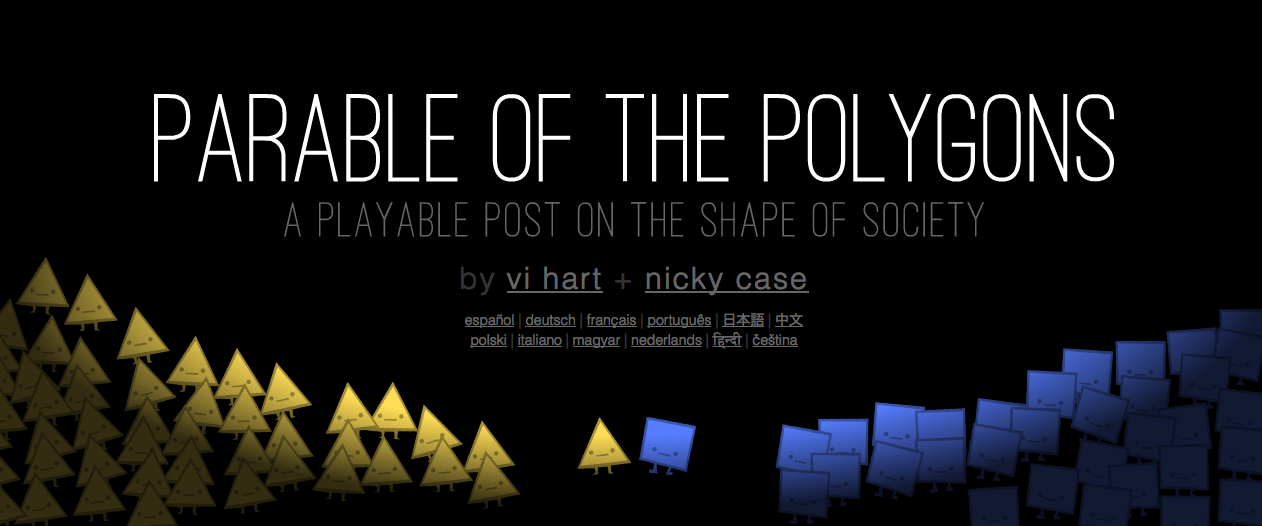
Thanks to Vi Hart @vihartvihart and Nicky Case @ncasenmare, we now have a fun, interactive model to understand systemic segregation that's appropriate for kids (and adults) of all ages!
Parable of the Polygons
http://ncase.me/polygons/
I heard about this model over the weekend and was so excited about it, I tried it out on my 7th grade media arts students today. I didn't even give them their own machines, I just walked them through it.
Even then, the students were totally able to grasp the rules of the system, and understand how systems create the world around us. They were entranced. One student who was class clowning that day remarked without irony, "Whoa, this is, like, really deep."
Next time, I'm going to set each student up at a machine, so they can click and drag through it on their own - experimenting, testing, hypothesizing, and proving their own assumptions either true or false.
Systems are important in media arts, because when you tell a story, you create a system for the audience. You create a setting, and you define (implicitly or explicitly) its boundaries. You create characters, and you define the parameters of their interaction. You define what powers each character has, and the latitude for each in terms of ability and mobility. You define what success and failure means in this system. Most important of all: when you mass communicate a system and it becomes popular, it inspires audience members to deploy that system in real life. Thus, we must be cautious as storytellers what systems we're popularizing.
Thursday, February 11, 2016
ComputerCraft Maze Challenge
Three cheers to Alexandria, the first of my students to successfully program her robot 'turtle' to navigate the maze she created in ComputerCraft!
ComputerCraft is a mod for MinecraftEdu that allows students to program robots called 'turtles' to do various in-game tasks.
It's got a fun, easy to use drag-and-drop visual programming language.
I think it's a reference to the turtle that students in the 80s (including myself) learned to program using LOGO.
ComputerCraft is a mod for MinecraftEdu that allows students to program robots called 'turtles' to do various in-game tasks.
It's got a fun, easy to use drag-and-drop visual programming language.
I think it's a reference to the turtle that students in the 80s (including myself) learned to program using LOGO.
Thursday, February 4, 2016
Teen Stops Cyber-Bullying Before It Starts
A 14 year-old girl developed software to reduce cyber-bullying by 93%, which still allows online access to students.
Trisha Prabhu from Illinois heard the stories of teen tragedies involving cyber-bullying, and she was driven to make a difference.
Social media developers haven't done enough to prevent abuse, and Twitter recently admitted this.
I teach social media safety, and when it came to the old adage of 'think before you post', I never felt that the curriculum available to me was reaching the students.
For example, look at how many different versions of this same message abound online:
Don't get me wrong, I agree with it. It's just, as an adult, I can see clearly on a daily basis that even adults have a hard time following these guidelines.
When I saw this post a couple weeks ago on Twitter about a technology that dramatically reduces online bullying, I was thrilled.
Trisha's TEDxTeen presentation is fantastic for high school students.
I'm currently teaching 6th graders, so I edited a version of her talk that removes the graphic details of teen suicides.
Trisha's software is called ReThink, and it simply identifies hurtful messages and asks the person to rethink their message before sending. It's prevented 93% of hurtful messages in trials. It's being developed for desktop and mobile use.
Trisha Prabhu from Illinois heard the stories of teen tragedies involving cyber-bullying, and she was driven to make a difference.
Social media developers haven't done enough to prevent abuse, and Twitter recently admitted this.
I teach social media safety, and when it came to the old adage of 'think before you post', I never felt that the curriculum available to me was reaching the students.
For example, look at how many different versions of this same message abound online:
Don't get me wrong, I agree with it. It's just, as an adult, I can see clearly on a daily basis that even adults have a hard time following these guidelines.
When I saw this post a couple weeks ago on Twitter about a technology that dramatically reduces online bullying, I was thrilled.
Trisha's TEDxTeen presentation is fantastic for high school students.
I'm currently teaching 6th graders, so I edited a version of her talk that removes the graphic details of teen suicides.
Trisha's software is called ReThink, and it simply identifies hurtful messages and asks the person to rethink their message before sending. It's prevented 93% of hurtful messages in trials. It's being developed for desktop and mobile use.
Saturday, January 30, 2016
Lesson Reflection - Anonymity in Online Gaming
Even within 10 minutes of an in-class lesson, the power of anonymity led at least one student away from community goals.
I'm teaching students, and they're often teaching me, through MinecraftEdu as a school club.
MinecraftEdu is a version of Minecraft where teachers can control & limit what each student is able to do.
In this Minecraft club, we're using a mod called ComputerCraft, in which students can learn visual computer programming to control in-game robots.
Before our club met, I had just finished talking with another group of students about social media safety. We discussed the advantages and disadvantages of being anonymous online.
Their responses were mostly about safety, at first. It's much safer, from a personal perspective, to be anonymous. When the focus moved to community-oriented behavior, students reflected that anonymity also allows people to do and say bad things and get away with it.
So, right after that class ended and Minecraft club began, all the kids signed on with made-up names. Pretty soon, a bunch of complaints cropped up about a player dropping slowness potions on people.
No one was willing to own the behavior.
I'd turned off most features that would tempt students to harm each other, and we set norms, but the issue of anonymity wasn't one of our norms.
MY BAD!
I'd made the mistake of assuming that, with teacher-assigned groups, and us all being present in the same room, with clear assignment instructions and expectations, that we'd know who's who.
Step 1, revisit the norms.
Step 2, figure out how to restrict potions.
I'm teaching students, and they're often teaching me, through MinecraftEdu as a school club.
MinecraftEdu is a version of Minecraft where teachers can control & limit what each student is able to do.
In this Minecraft club, we're using a mod called ComputerCraft, in which students can learn visual computer programming to control in-game robots.
Before our club met, I had just finished talking with another group of students about social media safety. We discussed the advantages and disadvantages of being anonymous online.
Their responses were mostly about safety, at first. It's much safer, from a personal perspective, to be anonymous. When the focus moved to community-oriented behavior, students reflected that anonymity also allows people to do and say bad things and get away with it.
So, right after that class ended and Minecraft club began, all the kids signed on with made-up names. Pretty soon, a bunch of complaints cropped up about a player dropping slowness potions on people.
No one was willing to own the behavior.
I'd turned off most features that would tempt students to harm each other, and we set norms, but the issue of anonymity wasn't one of our norms.
MY BAD!
I'd made the mistake of assuming that, with teacher-assigned groups, and us all being present in the same room, with clear assignment instructions and expectations, that we'd know who's who.
Step 1, revisit the norms.
Step 2, figure out how to restrict potions.
Wednesday, January 27, 2016
Lesson Reflection: Instagram Envy
Instagram envy is a thing, and sometimes I feel it. There's sometimes a teeny tiny giddy thrill behind the motivation to post a new photo to my account on the rare occasion I'm witnessing something beautiful IRL.
This NYT article is great: http://www.nytimes.com/2013/12/15/fashion/instagram.html
I read the first few paragraphs with 6th graders, and they were really engaged by the interactivity of the actual Instagram posts linked into the story. "Like it!" They made me 'like' each one of the photos of Thanksgiving dishes and delights. It gave them a thrill that they interacted directly with the person the NYT featured.
I then showed them Socality Barbie, which is my favorite Instagram account.
http://www.theatlantic.com/entertainment/archive/2015/09/hipster-socality-barbie-shows-the-cliche-of-instagram-authenticity/404431/
Socality Barbie's metaphor is clear enough even for tweens to understand. On a side note, it's a great opportunity for 6th graders to unpack the harmful stories the toy industry capitalizes off of with dolls like Barbie, Nerf gatling guns, etc.
I created this infographic to establish the less desirable dynamics that kids encounter as they step into online social spaces for the first time:
The infographic led into discussions about gamer culture, which I'll get into tomorrow.
Some students said in rebuttal of our discussion of (6th grade appropriate) examples of hazing that trust is an issue in gaming environments.
We talked about trust. Trust is earned. Is hazing an ordeal that earns someone trust, or does it go too far and enforce loyalty, instead?
One student shared an experience of being threatened in an online game. The anonymous player threatened to hack this student's account, and suddenly began sending text to an unrelated personal device belonging to the student. Scary!
From here, we're going to talk about how to welcome those outliers into the crowd of kindness, as well as how to move oneself away from the fringe and make kinder choices in online communication. One great example of people doing this work is found here:
https://blog.dosomething.org/happiness-hackathon/
This NYT article is great: http://www.nytimes.com/2013/12/15/fashion/instagram.html
I read the first few paragraphs with 6th graders, and they were really engaged by the interactivity of the actual Instagram posts linked into the story. "Like it!" They made me 'like' each one of the photos of Thanksgiving dishes and delights. It gave them a thrill that they interacted directly with the person the NYT featured.
I then showed them Socality Barbie, which is my favorite Instagram account.
http://www.theatlantic.com/entertainment/archive/2015/09/hipster-socality-barbie-shows-the-cliche-of-instagram-authenticity/404431/
Socality Barbie's metaphor is clear enough even for tweens to understand. On a side note, it's a great opportunity for 6th graders to unpack the harmful stories the toy industry capitalizes off of with dolls like Barbie, Nerf gatling guns, etc.
I created this infographic to establish the less desirable dynamics that kids encounter as they step into online social spaces for the first time:
The infographic led into discussions about gamer culture, which I'll get into tomorrow.
Some students said in rebuttal of our discussion of (6th grade appropriate) examples of hazing that trust is an issue in gaming environments.
We talked about trust. Trust is earned. Is hazing an ordeal that earns someone trust, or does it go too far and enforce loyalty, instead?
One student shared an experience of being threatened in an online game. The anonymous player threatened to hack this student's account, and suddenly began sending text to an unrelated personal device belonging to the student. Scary!
From here, we're going to talk about how to welcome those outliers into the crowd of kindness, as well as how to move oneself away from the fringe and make kinder choices in online communication. One great example of people doing this work is found here:
https://blog.dosomething.org/happiness-hackathon/
Monday, November 16, 2015
Lesson Reflection: Tropes vs Women in Video Games
Today I showed Feminist Frequency's video Tropes Vs Women in Video Games Pt 1, starring Anita Sarkeesian, to a new group of students, and then I showed them examples of censored tweets from angry gamers. Here are my reflections from that lesson:
-It never fails - each time I show this video, boys are snickering at the ridiculous female caricatures, such as Princess Daphne from Dragon's Lair. Once the video ends, and after discussion I show them the threatening tweets, they are the most interested group of students in the room. They get out of their chairs and approach the screen, as if to indicate that they need to absorb all the horror of it.
-The archival clip from the TV spot for Legend of Zelda: Ocarina of Time says "Willst thou get the girl? Or play like one?" This insult lands really heavily on the class. No one tries to defend the ad. It serves as an entry point into the emotions of the haters, who champion this game, but don't know what it means to be critical of it while also appreciating its place in game history.
-I really want to introduce the bell curve tomorrow, with kindness in the middle and the pernicious outliers defined in both categories.
-This lesson is always the one that ends up impacting the students most. When I survey them afterwards, they almost always unanimously cite Anita's work as the most memorable part of the unit.
-Should I scroll down the gg hashtag in Twitter? I can't really do that because of the bad language, but I suppose that I can take screenshots.
-I just went into a gg black hole. It is a HUGE community.
-It never fails - each time I show this video, boys are snickering at the ridiculous female caricatures, such as Princess Daphne from Dragon's Lair. Once the video ends, and after discussion I show them the threatening tweets, they are the most interested group of students in the room. They get out of their chairs and approach the screen, as if to indicate that they need to absorb all the horror of it.
-The archival clip from the TV spot for Legend of Zelda: Ocarina of Time says "Willst thou get the girl? Or play like one?" This insult lands really heavily on the class. No one tries to defend the ad. It serves as an entry point into the emotions of the haters, who champion this game, but don't know what it means to be critical of it while also appreciating its place in game history.
-I really want to introduce the bell curve tomorrow, with kindness in the middle and the pernicious outliers defined in both categories.
-This lesson is always the one that ends up impacting the students most. When I survey them afterwards, they almost always unanimously cite Anita's work as the most memorable part of the unit.
-Should I scroll down the gg hashtag in Twitter? I can't really do that because of the bad language, but I suppose that I can take screenshots.
-I just went into a gg black hole. It is a HUGE community.
Thursday, October 22, 2015
Story Globe
I just went to This American Life's website recently and noticed the Story Globe feature. It's a world map with little dots all over it. Each dot is a story that relates to that location. Click on a dot and listen!
Here's what it looks like (image only)
A diverse selection of stories, presented in a more inclusive way. Happy travels!
Thursday, October 15, 2015
The Profile Pic and Teen Identity
Warning: This might bring back some best forgotten teen memories about identity development.
What's your favorite social media site?
What makes a good profile pic on that site?
Each social media site has its own unwritten rules about profile pics, and looking deeper into teen choices about them reveal issues of identity development, as well as emotional abuse.
When you turn 13, you're suddenly of legal age to join the world of social media.
If you're a 12yo, like the 7th graders in my Social Media Safety class, you might have a social media account already, on the conditions that you already own a smartphone, and your parents allow you to create online accounts. If you don't, it is because one or both of those conditions are false.
"But everyone else at school has an Instagram!"
Can a child younger than age 13 use social media?
Social media sites are all regulated by COPPA, the Children's Online Privacy Protection Act, which sets limits on data collection from users under age 13.
The enforcement and effectiveness of COPPA is, apparently, about as potent as MPAA's PG-13 rating, because when I ask my 12yo students if they use some form of social media regularly, 80-90% of them raise their hands.
They also all admit to having seen a PG-13 movie.
COPPA has had 24 cases in 14 years, which is an indication of the level of enforcement.
Pew Research Center on Internet, Science and Tech published findings from this year about teen trends in social media use, and this gender divide graph gets at a fundamental difference in the use of the profile pic:
CNN recently debuted #Being13, a documentary about what it looks like at age 13 these days, when suddenly a child has entered their teenage years, at the beginning of (perhaps a lifetime of) social media use.
The caption below this image reads: "I like made this google document on all my rules and requirements on how to take a selfie. I take a lot of pictures, but don't judge, I take like 100 usually, or like 150, maybe 200 sometimes if I really can't get a right one."
A Google Image Search on Instagram profile pics yields this array:
It might be hard to see, and you can click here to see for yourself, but nearly all of these profile pics are faces of (presumably) the actual account holders.
I corroborated this presumption with my 7th graders, who confirm that this is indeed the trend on Instagram. That way, even though your username might be different from your real name, your followers will know whose account it is. At least in teen Instagram land, this is important. Besides, if you're going to post a selfie, everyone will know it's your account anyway.
There's little room for anonymity in teen Instagram land.
Let's jump to the other side of the gender spectrum, where (according to Pew) 84% of teen boys play online games.
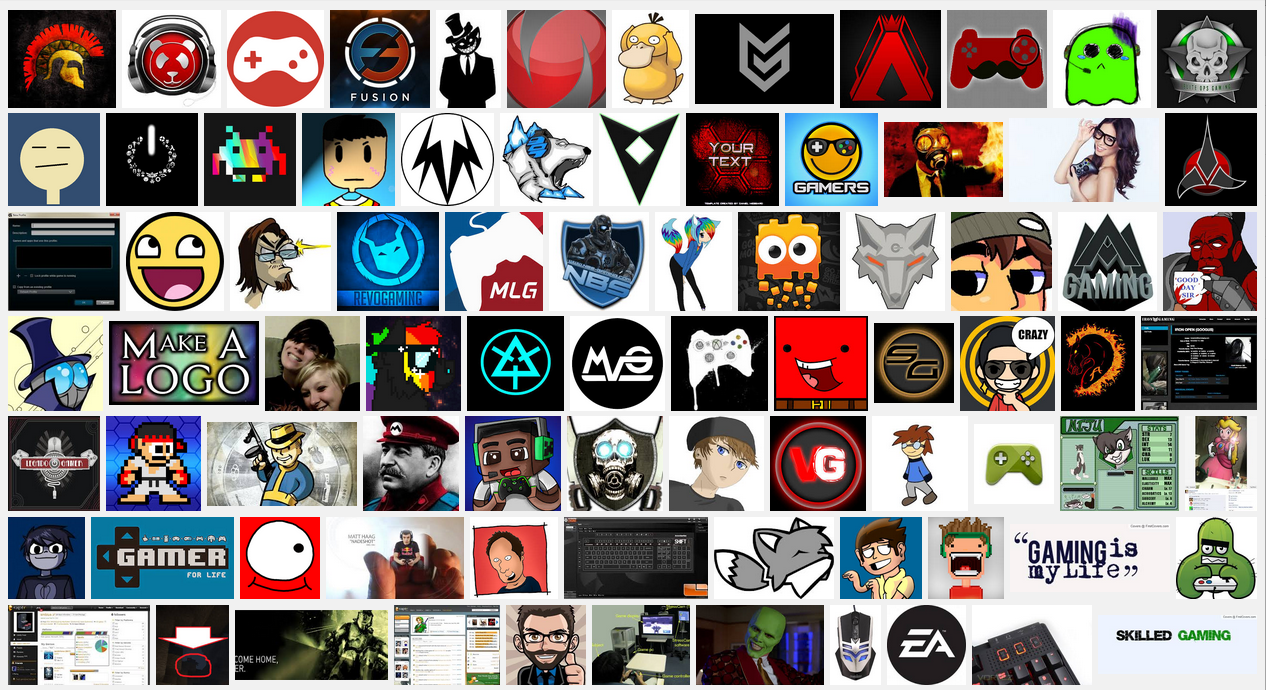
A Google Image Search of "gamer profile pics" produces a very different result:
None of these images are a teen's actual face, and in this search, there's a naked woman holding a game controller.
There are very few selfies in gaming culture.
Anonymity is very important among gamers.
I ask my students why this is? Boys explain that if you post your actual face, everyone will make fun of you.
Why?
"Because that's just how it works."
That is a loaded response. We spent some time unpacking that one.
The trouble with anonymity in gamer culture is well documented in the news surrounding #gamergate.
My students were quick to point out the cons of anonymity:
"You can hit and run."
What's that?
"It's when you say something mean and get away with it, because no one knows who you are."
Gamer culture is changing, thanks in no small part to Feminist Frequency's series Tropes Vs Women in Video Games, which is A+ fantastic, and many of the videos are appropriate for the classroom (screen them first obvs!)
In my classroom, by pointing out this dramatic difference in profile pic culture, I was shocked how quickly I found myself at the gates to this world of online abuse.
Back in teen Instagram land, when talking about pros and cons of the selfie profile pic, I quickly received this response:
"You can make yourself look really pretty & fancy."
Indeed, some of the most popular photo editing apps offer specific tools to whiten your teeth, shape your eyebrows, raise your cheekbones, enlarge your eyes, erase blemishes, and more.
Identity development is hard work, and it takes a lot of support from friends and family to get through those teen years and stay afloat.
All of this brings back some memories of my middle school years for sure.
The #Being13 takeaway that opened my eyes as a teacher guiding 13yos safely into their online lives is that the difficulties they encounter can be greatly lessened simply if their parents follow their accounts.
That's great to know! If you're reading this, you might want to consider sharing with parents the linked article above about #Being13, as well as the documentary itself. Parents I've talked to that watched it expressed the importance of viewing it with their teens at home.
It led me to a question:
If we know that middle schoolers need guidance IRL (in real life), might they need just as much guidance in online spaces? If they receive guidance not only from their parents IRL, but also from their teachers, coaches, other family members etc, perhaps more of these folks ought to be a part of their online life, too?
What's your favorite social media site?
What makes a good profile pic on that site?
Each social media site has its own unwritten rules about profile pics, and looking deeper into teen choices about them reveal issues of identity development, as well as emotional abuse.
When you turn 13, you're suddenly of legal age to join the world of social media.
If you're a 12yo, like the 7th graders in my Social Media Safety class, you might have a social media account already, on the conditions that you already own a smartphone, and your parents allow you to create online accounts. If you don't, it is because one or both of those conditions are false.
"But everyone else at school has an Instagram!"
Can a child younger than age 13 use social media?
Social media sites are all regulated by COPPA, the Children's Online Privacy Protection Act, which sets limits on data collection from users under age 13.
The enforcement and effectiveness of COPPA is, apparently, about as potent as MPAA's PG-13 rating, because when I ask my 12yo students if they use some form of social media regularly, 80-90% of them raise their hands.
They also all admit to having seen a PG-13 movie.
COPPA has had 24 cases in 14 years, which is an indication of the level of enforcement.
Pew Research Center on Internet, Science and Tech published findings from this year about teen trends in social media use, and this gender divide graph gets at a fundamental difference in the use of the profile pic:
CNN recently debuted #Being13, a documentary about what it looks like at age 13 these days, when suddenly a child has entered their teenage years, at the beginning of (perhaps a lifetime of) social media use.
The caption below this image reads: "I like made this google document on all my rules and requirements on how to take a selfie. I take a lot of pictures, but don't judge, I take like 100 usually, or like 150, maybe 200 sometimes if I really can't get a right one."
A Google Image Search on Instagram profile pics yields this array:
It might be hard to see, and you can click here to see for yourself, but nearly all of these profile pics are faces of (presumably) the actual account holders.
I corroborated this presumption with my 7th graders, who confirm that this is indeed the trend on Instagram. That way, even though your username might be different from your real name, your followers will know whose account it is. At least in teen Instagram land, this is important. Besides, if you're going to post a selfie, everyone will know it's your account anyway.
There's little room for anonymity in teen Instagram land.
Let's jump to the other side of the gender spectrum, where (according to Pew) 84% of teen boys play online games.
A Google Image Search of "gamer profile pics" produces a very different result:
None of these images are a teen's actual face, and in this search, there's a naked woman holding a game controller.
There are very few selfies in gaming culture.
Anonymity is very important among gamers.
I ask my students why this is? Boys explain that if you post your actual face, everyone will make fun of you.
Why?
"Because that's just how it works."
That is a loaded response. We spent some time unpacking that one.
The trouble with anonymity in gamer culture is well documented in the news surrounding #gamergate.
My students were quick to point out the cons of anonymity:
"You can hit and run."
What's that?
"It's when you say something mean and get away with it, because no one knows who you are."
Gamer culture is changing, thanks in no small part to Feminist Frequency's series Tropes Vs Women in Video Games, which is A+ fantastic, and many of the videos are appropriate for the classroom (screen them first obvs!)
In my classroom, by pointing out this dramatic difference in profile pic culture, I was shocked how quickly I found myself at the gates to this world of online abuse.
Back in teen Instagram land, when talking about pros and cons of the selfie profile pic, I quickly received this response:
"You can make yourself look really pretty & fancy."
Indeed, some of the most popular photo editing apps offer specific tools to whiten your teeth, shape your eyebrows, raise your cheekbones, enlarge your eyes, erase blemishes, and more.
Identity development is hard work, and it takes a lot of support from friends and family to get through those teen years and stay afloat.
All of this brings back some memories of my middle school years for sure.
The #Being13 takeaway that opened my eyes as a teacher guiding 13yos safely into their online lives is that the difficulties they encounter can be greatly lessened simply if their parents follow their accounts.
That's great to know! If you're reading this, you might want to consider sharing with parents the linked article above about #Being13, as well as the documentary itself. Parents I've talked to that watched it expressed the importance of viewing it with their teens at home.
It led me to a question:
If we know that middle schoolers need guidance IRL (in real life), might they need just as much guidance in online spaces? If they receive guidance not only from their parents IRL, but also from their teachers, coaches, other family members etc, perhaps more of these folks ought to be a part of their online life, too?
Wednesday, September 16, 2015
XOXO Is For Educators
Story.
Arcade.
Tabletop.
Film/Animation.
Conference.
Music.
XOXO is an arts and technology conference that curates examples of creativity and innovation that disrupt the status quo in social and professional contexts. It began in 2012 by two Andys, Andy Baio (of Upcoming, Kickstarter, and Waxy), and Andy McMillan of Build and The Manual, and has been held in Portland, OR.
Story
Our students, whether they're 2 or 22 years old, have encountered storytelling in various forms, and are learning both from these stories, as well as how to share their own via this multitude of avenues. At this year's XOXO, I attended a few of these marvelous examples of storytelling that I think serve as wonderful models for potential student projects:
Fray Cafe: "Before The Moth, before Risk!, before Mortified, before Snap Judgement, there was Fray Cafe. 5 minutes. One live microphone. Your stories." At this event, I heard stories told live about saving a new neighbor's life, the decision to go on antidepressants, and a near death experience while lost on a desert hiking trail. Imagine live (rehearsed) storytelling at school assemblies!
Reply All: "Stories about how people shape the internet, and the internet shapes people." I had the joy of witnessing PJ Vokt and Alex Goldman perform a live taping of an episode at XOXO for this podcast. I am in love with podcasts, and what a great medium for students to share new knowledge, process and reflect, and demonstrate understanding.
Arcade
Video games are now being played by equal numbers of people of all genders and ages. It was recently announced that the largest demographic of gamers is adult women. Our students play games, but, as president Obama said, today's youth should stop playing games and start making them.
Hyper Light Drifter: Heart Machine's highly-anticipated indie game was funded by a blockbuster Kickstarter project that raised over $645k from 25,150 backers in 2013. The fast-paced 2D action RPG was inspired by SNES classics, and creator Alex Preston’s congenital heart condition. Heart Machine designer/developer Teddy Deifenbach talked with me about what could attract middle school gamers: "The character has a heart condition, but kids might not get that. They'll connect to the adventure story, and enjoy exploring around the big game world." Using tools like Game Maker, Gamesalad, RPG Maker, Twine, and Scratch, students can design their own games (and learn some basic javascript along the way) that tell any story they like.
Tacoma: Fullbright's follow-up to Gone Home was debuted as a playable demo, where you get to explore an abandoned space station to solve the mystery of the missing crew. I spoke with Fullbright's Karla Zimonja, who is an active supporter of young people learning new narratives through video games. Tacoma is being designed using Unity, which is an app students can use for free.
Feminist Frequency: One aspect of video games that's important to address and think critically about is how inclusive the medium is for wide audiences. When students are crafting game narratives, it's important that they consider their audience, and strive for inclusivity. Anita Sarkeesian hosts and produces a webseries called Feminist Frequency that "explores the representations of women in pop culture narratives." These videos are meticulously crafted, exhaustively researched, and highly regarded in the industry as truly game-changing (no pun intendo) analyses on the history, current state, and future of the art. Sarkeesian spoke at XOXO about the evolution and reach of this series, and I'll share one video here that is appropriate for teens in the classroom:
There's so much more to share - perhaps in another post! What I enjoyed most from XOXO was being inspired by the ways these professionals are engaging with and reshaping our world. I aim to pass on this inspiration to my students, show them what sorts of 21st century career paths await, and guide them in gaining some skills that will start them on their path.
Arcade.
Tabletop.
Film/Animation.
Conference.
Music.
XOXO is an arts and technology conference that curates examples of creativity and innovation that disrupt the status quo in social and professional contexts. It began in 2012 by two Andys, Andy Baio (of Upcoming, Kickstarter, and Waxy), and Andy McMillan of Build and The Manual, and has been held in Portland, OR.
Story
Our students, whether they're 2 or 22 years old, have encountered storytelling in various forms, and are learning both from these stories, as well as how to share their own via this multitude of avenues. At this year's XOXO, I attended a few of these marvelous examples of storytelling that I think serve as wonderful models for potential student projects:
Fray Cafe: "Before The Moth, before Risk!, before Mortified, before Snap Judgement, there was Fray Cafe. 5 minutes. One live microphone. Your stories." At this event, I heard stories told live about saving a new neighbor's life, the decision to go on antidepressants, and a near death experience while lost on a desert hiking trail. Imagine live (rehearsed) storytelling at school assemblies!
Reply All: "Stories about how people shape the internet, and the internet shapes people." I had the joy of witnessing PJ Vokt and Alex Goldman perform a live taping of an episode at XOXO for this podcast. I am in love with podcasts, and what a great medium for students to share new knowledge, process and reflect, and demonstrate understanding.
Arcade
Video games are now being played by equal numbers of people of all genders and ages. It was recently announced that the largest demographic of gamers is adult women. Our students play games, but, as president Obama said, today's youth should stop playing games and start making them.
Hyper Light Drifter: Heart Machine's highly-anticipated indie game was funded by a blockbuster Kickstarter project that raised over $645k from 25,150 backers in 2013. The fast-paced 2D action RPG was inspired by SNES classics, and creator Alex Preston’s congenital heart condition. Heart Machine designer/developer Teddy Deifenbach talked with me about what could attract middle school gamers: "The character has a heart condition, but kids might not get that. They'll connect to the adventure story, and enjoy exploring around the big game world." Using tools like Game Maker, Gamesalad, RPG Maker, Twine, and Scratch, students can design their own games (and learn some basic javascript along the way) that tell any story they like.
Tacoma: Fullbright's follow-up to Gone Home was debuted as a playable demo, where you get to explore an abandoned space station to solve the mystery of the missing crew. I spoke with Fullbright's Karla Zimonja, who is an active supporter of young people learning new narratives through video games. Tacoma is being designed using Unity, which is an app students can use for free.
Feminist Frequency: One aspect of video games that's important to address and think critically about is how inclusive the medium is for wide audiences. When students are crafting game narratives, it's important that they consider their audience, and strive for inclusivity. Anita Sarkeesian hosts and produces a webseries called Feminist Frequency that "explores the representations of women in pop culture narratives." These videos are meticulously crafted, exhaustively researched, and highly regarded in the industry as truly game-changing (no pun intendo) analyses on the history, current state, and future of the art. Sarkeesian spoke at XOXO about the evolution and reach of this series, and I'll share one video here that is appropriate for teens in the classroom:
There's so much more to share - perhaps in another post! What I enjoyed most from XOXO was being inspired by the ways these professionals are engaging with and reshaping our world. I aim to pass on this inspiration to my students, show them what sorts of 21st century career paths await, and guide them in gaining some skills that will start them on their path.
Wednesday, September 2, 2015
Gone Home In The Classroom
Gone Home by Fullbright is one of the most inclusive stories in video game history, and my students played it together to talk about tropes in video games.
The students even got to visit Fullbright and ask the game developers questions!
First, some context:
I was leading a game design summer camp and ended up with a dozen boys - no girls enrolled. I wanted to treat it like an affinity group for male gamers.
The tech industry has always been a major cultural battlefield for women, due to push back and misogynistic attacks from male industry folk.
As the Daily Dot reported, the largest demographic in gaming is adult women, although the stories they encounter are largely dominated by male characters, while female characters are often objectified, typecast, victimized, and/or otherwise marginalized - usually non-playable.
These gender tropes are deconstructed so well in the series Tropes Vs Women in Video Games by YouTube channel Feminist Frequency, that it has earned worldwide attention with 200,000 subscribers and 20 million views to date.
Gone Home, on the other hand, stars a young woman, includes LGBT characters, and constructs a narrative that cleverly sets the player up to expect one kind of archetypal story by using several tropes of the "survival horror" genre, only to find a very different story that nimbly unfolds within 2 or 3 hours of gameplay.
The game received 7 perfect scores from sites as reputable as Giant Bomb and Polygon.
Gone Home in the classroom:
Fullbright was very generous and donated copies of Gone Home for my students to play. I didn't tell my students anything about the game, except that I'd scheduled a visit to Fullbright later that week, and that they needed to think of questions to ask the game developers.
What I did talk about with students involved a more general discussion around gender and video games, fit for a male gamer affinity group just beginning to talk about this topic.
We generated this list of games starring playable female characters:
Metroid
Tomb Raider
Mirror's Edge
Portal
Last of Us
Ms. Pac-Man
Students were proud to know these titles, and they were happy to see such representation of female characters in games, until we all quickly ran out of titles to add. (Here's an online list, including supporting and non-playable characters).
We were able to make a long list of games where female characters needed to be saved by male characters.
When it came time to play Gone Home, my students played through it pretty quickly - within 2 or 3 hours. As a homework assignment, it could be spread out through a few days.
NOTE: The game is rated for players aged 16 and older.
The students really enjoyed the game, and they asked the game developers, Steve Gaynor and Karla Zimonja, several thought-provoking questions, that I won't include, because they're spoilers!
Their experience playing Gone Home in the classroom was very social. It started out with kids comparing progress with each other, punctuated by the occasional scream of anticipation, imagining what they might find rounding the next creepy corner of game space.
By the end of the game, all they were talking about was the story. They were comparing notes with each other, trying to piece it together, one clue at a time.
This kind of story was new to them, and no one wrote it off. They were compelled to see the complete picture, as if they were afraid to miss a single detail. The boys talked about the LGBT aspect of the story like it was the norm (which gave me great hope for the next generation), but they weren't talking about it with the fluency that comes with comfort and experience. I'd wager that this game brought them one step closer to feeling comfortable discussing LGBT issues among male peers.
Gone Home is interactive literature, and the buy-in that came with its well-designed gameplay was 100% effective in engaging a group of teen boys. It set the stage for an entire course about inclusive storytelling.
Who does this story welcome in? Who is this story about? Who might not feel represented in this story? As the story plays out, who wins? Who loses? Who's in danger? Who might feel unsafe or powerless as they hear this story?
Here were some of the takeaways that kids wanted to share with Fullbright after their visit:
"I loved hearing about how Gone Home was made - how it was supposed to be horror, and how you interviewed people and based it off their experiences."
"I loved the attention to detail in the level design."
"Thank you for not only presenting to us your individual jobs, but the way you design great games as a team. I hope to play Tacoma once it's published!"
"Thanks to your group for showing us how a great game can be made with a small group of talented people."
"I loved Christmas Duck and seeing the artwork Karla was working on."
Gone Home is my favorite game, so I also really enjoyed meeting its designers, Steve and Karla. Here's a photo of us with Christmas Duck, who plays a major role in the game.
For more information, here's a great feature on Gone Home and its connection to the Gamergate controversy.
Subscribe to:
Posts (Atom)